



Werner Sombart-- Jews and their Temperament
August 19, 2023
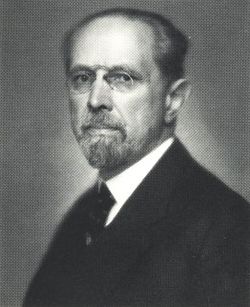 (left, The distinguished German sociologist Werner Sombart, 1863-1941,
 was an informed and generally sympathetic observer of the Jewish people.)
In his book "The Jews & Modern Capitalism," (1911)
Sombart credits Jews for the rise of capitalism,
the most dynamic force in the modern world.
In the excerpt below (from pp. 183-7) he describes
Jews as overly intellectual and goal-oriented.
In the words of Goethe, "No Jew, not even the most insignificant, but is busy towards the achievement of some worldly, temporary or momentary aim... This activity often enough degenerates into restlessness. He must forever be up and doing, forever managing something and carrying it to fruition."
Makow- Jordan Peterson recently attributed Jewish domination to higher IQ's. I disagree. Most Jews (and Freemasons) benefit because they are witting or unwitting accomplices in the central banking swindle (which allows the bankers to create the medium of exchange as a personal debt to them.)
However, there is another factor at play. Temperament. Many Jews are not temperamentally suited to enjoying life for its own sake. Life must constantly be justified and ameliorated. (This is why I don't have a hobby.) Jews generally don't run away and join the circus. We are a purposeful people. As Sombart says, the Jew "sets himself a goal and makes for it." Is this obsessive-compulsive?
There is also a metaphysical dimension. The essence of Judaism (and the NWO) is that the Jewish people (a.k.a the Masonic Jewish central bankers) will replace God. Somehow this template has burned itself into the collective mind. Thus the archetypal Jew is always busy destroying the old order and rebuilding ("healing") the universe to conform to his material interests, amour-propre, and perversions. (See Communism, socialism, liberalism etc.) Obviously, many Jews are focused on their personal lives and do not fit this model. But, like the goyim, they are manipulated by the media etc.
from April 3, 2018
by Werner Sombart
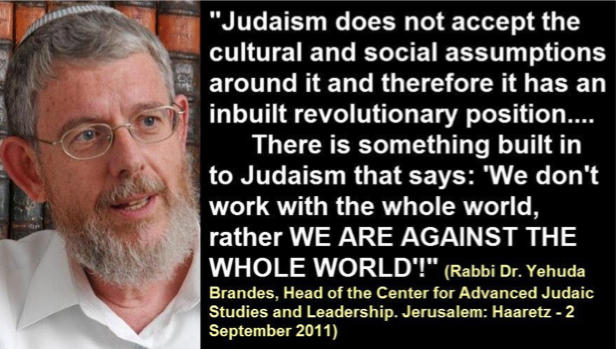
He brings everything into relation with his ego. He is forever asking why what for, what will it bring? Cui bono? His greatest interest is always in the result of a thing, not in the thing itself. It is un-Jewish to regard any activity, be it what you will, as an end in itself; un-Jewish to live your life without having any purpose, to leave all to chance; un-Jewish to get harmless pleasure out of Nature.
How deeply the teleological view of things is embedded in the nature of the Jew may be seen in the case of those of them who, like the Chassidim, pay no attention to the needs of practical life because "there is no purpose in them." There is no purpose in making a living, and so they let their wives and children starve, and devote themselves to the study of their sacred books.
When this attitude of mind that seeks for a purpose in all things is united with a strong will, with a large fund of energy (as is generally the case with the Jew), it ceases to be merely a point of view; it becomes a policy. The man sets himself a goal and makes for it, allowing nothing whatever to turn him aside from his course; he is determined, if you like, stiff-necked. Heine in characterizing his people called it stubbornness, and Goethe said that the essence of the Jewish character was energy and the pursuit of direct ends.
(edited & abridged by henrymakow.com)
The intellectuality of the Jew is so strong that it tends to develop at the expense of other mental qualities, and the mind is apt to become one-sided.
The Jew certainly sees remarkably clearly, but he does not see much.
The intellectuality of the Jew is so strong that it tends to develop at the expense of other mental qualities, and the mind is apt to become one-sided.
The Jew certainly sees remarkably clearly, but he does not see much.
He does not think of his environment as something alive, and that is why he has lost the true conception of life, of its oneness, of its being an organism, a natural growth. In short, he has lost the true conception of the personal side of life. General experience must surely support this view; but if other proofs are demanded they will be found in the peculiarities of Jewish law, which abolished personal relationships and replaced them by impersonal, abstract connections or activities or aims.
Hence the [Jewish] lack of sympathy for every status where the nexus is a personal one. The Jews' whole being is opposed to all that is usually understood by chivalry, to all sentimentality, knight-errantry, feudalism, patriarchalism. Nor does he comprehend a social order based on relationships such as these. "Estates of the realm" and craft organizations are a loathing to him.
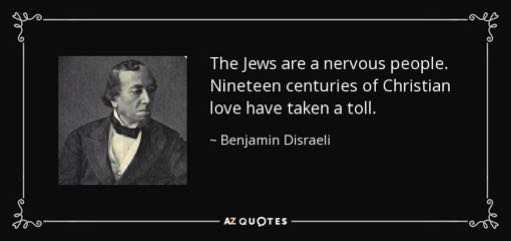 (Typically the Jew inverts everything. Reacting to Talmudic hate becomes Christian hate.)
Hence the [Jewish] lack of sympathy for every status where the nexus is a personal one. The Jews' whole being is opposed to all that is usually understood by chivalry, to all sentimentality, knight-errantry, feudalism, patriarchalism. Nor does he comprehend a social order based on relationships such as these. "Estates of the realm" and craft organizations are a loathing to him.
(Typically the Jew inverts everything. Reacting to Talmudic hate becomes Christian hate.)The conception of the universe in the mind of such an intellectual people must perforce have been that of a structure well-ordered in accordance with reason. By the aid of reason, therefore, they sought to understand the world; they were rationalists, both in theory and in practice.
Now as soon as a strong consciousness of the ego attaches itself to the predominating intellectuality in the thinking being, he will tend to group the world around that ego. In other words, he will look at the world from the point of view of the end, or goal, or purpose.
Examine any expression of the Jewish genius and you will be certain to find in it this teleological tendency, which has sometimes been called extreme subjectivity.
Whether or not the Indo-Germanic races are objective and the Semitic subjective, certain it is that the Jews are the most subjective of peoples. The Jew never loses himself in the outer world, never sinks in the depth of the cosmos, never soars in the endless realms of thought, but, as Jellinek well puts it, dives below the surface to seek pearls.
He brings everything into relation with his ego. He is forever asking why what for, what will it bring? Cui bono? His greatest interest is always in the result of a thing, not in the thing itself. It is un-Jewish to regard any activity, be it what you will, as an end in itself; un-Jewish to live your life without having any purpose, to leave all to chance; un-Jewish to get harmless pleasure out of Nature.
The Jew has taken all that is in Nature and made of it "the loose pages of a textbook of ethics which shall advance the higher moral life." The Jewish religion, as we have already seen, is teleological in its aim; in each of its regulations, it has the ethical norm in view. The entire universe, in the Jew's eyes, is something that was made in accordance with a plan.
No term is more familiar to the ear of the Jew than Tachlis, which means purpose, aim, end or goal. If you are to do anything it must have a tachlis; life itself, whether as a whole or in its single activities, must have some tachlis, and so must the universe. Those who assert that the meaning of Life, of the World, is not tachlis but tragedy, the Jew will reckon as foolish visionaries.
How deeply the teleological view of things is embedded in the nature of the Jew may be seen in the case of those of them who, like the Chassidim, pay no attention to the needs of practical life because "there is no purpose in them." There is no purpose in making a living, and so they let their wives and children starve, and devote themselves to the study of their sacred books.
When this attitude of mind that seeks for a purpose in all things is united with a strong will, with a large fund of energy (as is generally the case with the Jew), it ceases to be merely a point of view; it becomes a policy. The man sets himself a goal and makes for it, allowing nothing whatever to turn him aside from his course; he is determined, if you like, stiff-necked. Heine in characterizing his people called it stubbornness, and Goethe said that the essence of the Jewish character was energy and the pursuit of direct ends.
--
Related -
Werner Sombart -- Why America is Steeped in Jewishness
First Comment by JG
I know this is a worn out old cliche but there really are all kinds of Jews. They are not a carbon copy of each other. The Ashkenazi Jews might be the most intelligent and high energy people in the world but they can be some of the most wicked also. Barbara Streisand's old music really explains some of the inner feelings of the Jews. I think of the song 'People'. It's as if they want to be part of the norm of humanity but somehow can't. They seem to always be outside looking in. Jews may not show their love with words and hugs but when they do show love it's by their actions. I don't begrudge any of the wealth or positions that they have achieved in the world. They will work tirelessly and plan way ahead to reach their goals. For years the "Jews" built up the Gentiles in America. They were some of their most progressive labor leaders, lawyers, and almost everything else you can think of in the professional fields. Exactly when and how this all changed I do not know but a lot of the "Jews" today have been corrupted by the very doctrines of self-destruction they have promoted. Clarence Larkin once predicated in one of his books that if the "Jews" were to lose their morality it would have a devastating effect on the world because the Gentiles seem to overwhelmingly follow the "Jews". This prediction almost seems prophetic.
Tony B
I missed this article last time around. I had also never been aware of the below excerpt, or if I had read it I missed its force:
"No term is more familiar to the ear of the Jew than Tachlis, which means purpose, aim, end or goal. If you are to do anything it must have a tachlis; life itself, whether as a whole or in its single activities, must have some tachlis, and so must the universe."
It occurs to me that Christ showed the Israelites and Judeans of His time the proper place to direct that tachlis, as, by His time on earth, they had habitually misdirected it to purely worldly uses. Had they listened to Him and re-directed their energy to the true world, the supernatural in which we all will live for eternity after this natural life ends, the world today would likely be a peaceful place with proper aims for most people.
There is no reason for it not to happen in the present if a way is found to break the hold of the Satanic misdirection that is destroying the world; that hold now on both Jew and a large percentage of gentiles.
That way, of course, will always be Jesus Christ, Son of God as well as Very God, which is exactly why the devil has worked so hard through the centuries to make Him so hated by the bulk of Jews.





rt123 said (August 20, 2023):
Christianity is a sheeple-oriented religion of self-enslavement to [ the chosen ] Jewmasters. That is the practical worldly goal of Christians whether they admit or realize it or not.
A high average IQ by itself is evidently not enough for a minority race to establish dominance among humanity. IQ must be informed with a sufficient amount of valid political intelligence for an elite culture/group to dominate humanity.
Jews more so than any other group/collective have known for many centuries that money ( fiat or otherwise ) is the most important economic resource other than like-minded and only like-minded humanity; where an enemy or other opposition group cannot be counted on as being a resource.